
URL: https://flash.desy.de/@@siteview
Breadcrumb Navigation
Free-Electron Laser FLASH
News
FLASH is back in operation
After 14 month of shutdown, which has been used to transform the FLASH1 beamline into a modern externally seeded FEL, FLASH restarts its operation. Transmission of the electron bunch to the FLASH1 & FLASH2 beam dump as well as FLASH2 SASE already have been demonstrated. Further optimization of the the bunch and FEL properties is continued. After a commissioning phase FLASH will deliver again FEL radiaiotn to user experiments in November 2025.


FLASH is in shutdown
Since 10 June 2024, one of the two FEL beamlines at FLASH has been undergoing a comprehensive modernization, which will last until August 2025. The first beamline will be completely redesigned to support externally seeded FEL operation at 1 MHz. To this end, 110 meters of the beamline will be dismantled and rebuilt. The new setup will enable polarization control of FEL pulses with narrow bandwidths, ranging from 40 nm down to 4 nm. This upgrade is a significant step forward and opens up exciting new possibilities for research at FLASH.
DESY mourns the loss of Siegfried Schreiber
Siggi Schreiber, our dear friend, colleague, mentor and scientific head of the FLASH accelerator passed away on April 23, 2024, at age of 64.


During the almost 30 years in which Siggi worked at DESY he gained worldwide recognition for his pioneering work on RF guns and high gain FELs. In 2006 he took over the operations-coordination of the TESLA Test Facility (TTF) accelerator and in succession the machine coordination of the emerging FLASH user faciliy. The outstanding quality and originality of Siggi's scientific contributions especially to the development of FELs at DESY are highly valued by the international audience and will never be forgotten.
We thank him very much and will always remember him fondly.
We mourn with his family and will honor his memory.

25-Sep-2023: The new afterburner undulator with the technology of APPLE III to produce circular polarized SASE radiation
The undulator group of Markus Tischer together with Pavel Vagin has been produced a new technology with compact magnet systems to have circular polarized SASE radiation at FLASH2. The idea is to have third-harmonic optimised to provide photon energies around the L-edges of iron, chromium and nickel, thus paving the way for studies of ultrafast magnetisation dynamics.
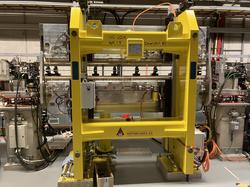
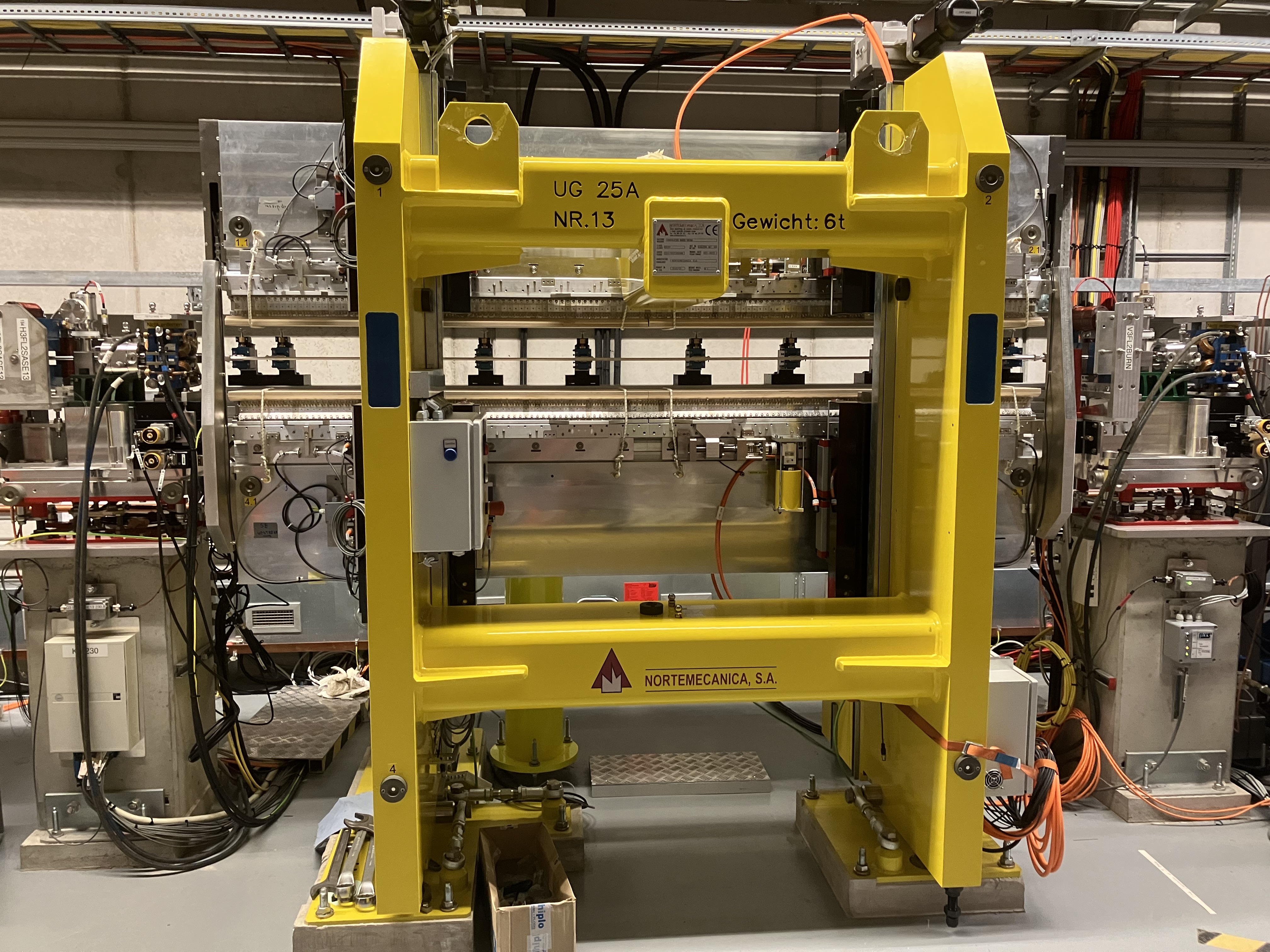
Afterburner undulator installed 25-Sep-2023 in the FLASH2 beamline.
After the news, let's continue with the description of the facility
FLASH, the world's first XUV and soft X-ray free-electron laser (FEL), is available to the photon science user community for experiments since 2005. Ultra-short X-ray pulses in the femtosecond range are produced using the SASE process. SASE is an abbreviation for Self-Amplified Spontaneous Emission. The SASE or FEL radiation has similar properties than optical laser beams: it is transversely coherent and can be focused to tiny spots with an irradiance exceeding 1016 W/cm2.
The FLASH facility operates two SASE beamlines in parallel: FLASH1 and FLASH2. The electron pulses of FLASH come in bursts of several hundred pulses, 10 bursts per second. The pulses of a burst are shared between the two beamlines providing FEL radiation for two experiments at the same time - with the full repetition rate of 10 Hz. A third beamline houses FLASHForward,
a pioneering beam-driven plasma-wakefield experiment.
Schematic layout of FLASH. Not to scale. The two main SASE beamlines FLASH1 and FLASH2 are in operation for user experiments. A third beamline runs the FLASHForward plasma acceleration experiment.
Image: DESY/Siegfried Schreiber

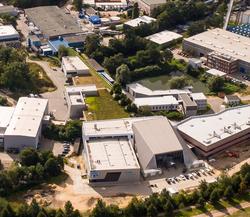
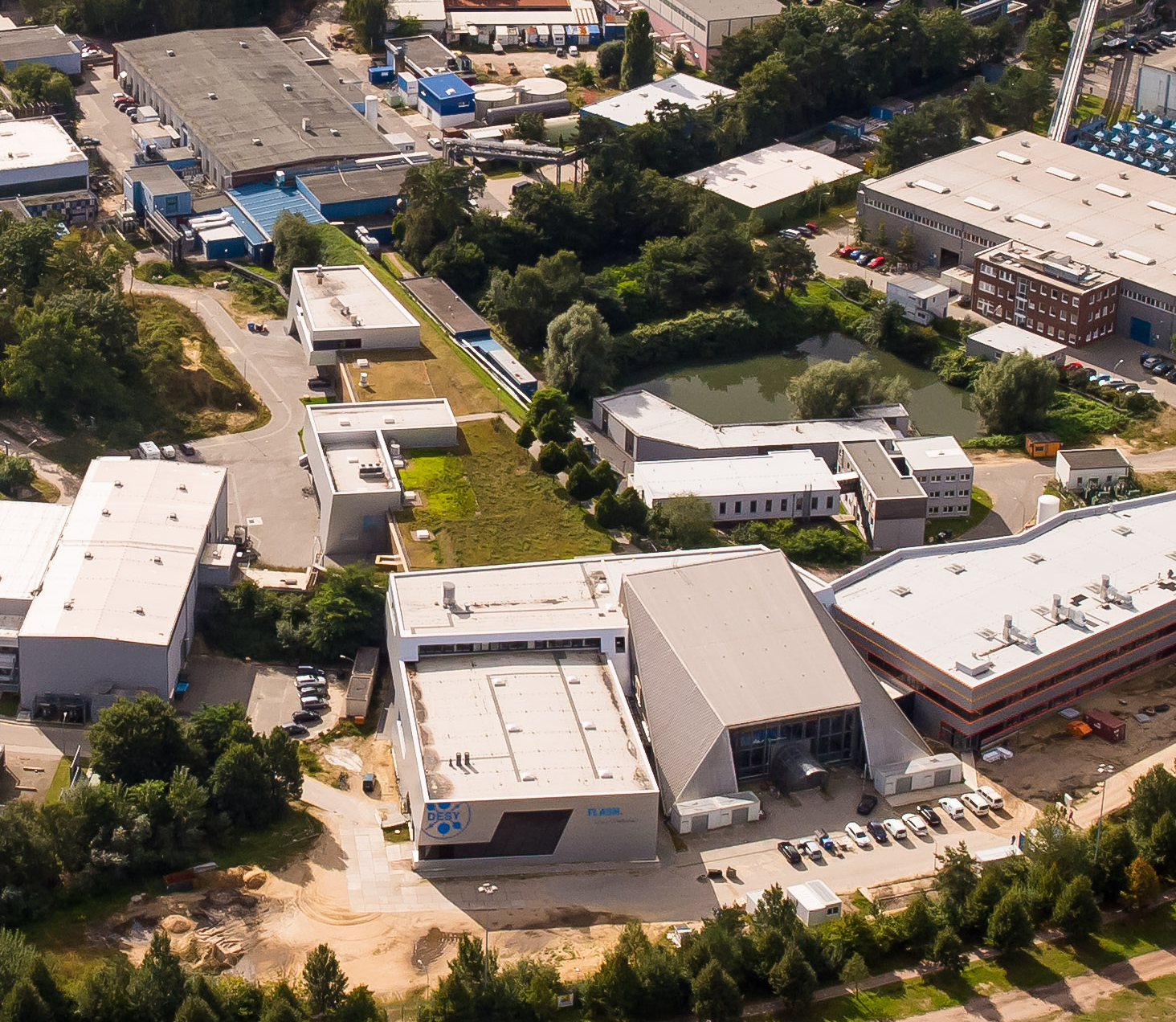
The aerial view shows the FLASH facility with its two experimental halls "Kai Siegbahn" and "Albert Einstein" (August 2015).
The SASE process is driven by high brightness electron beams. At FLASH1, the wavelength of the X-rays is tuned by choosing the right electron beam energy. The FLASH accelerator provides a range of electron beam energies between 350 MeV and 1.25 GeV covering a wavelength range between 52 and 4 nanometers (nm). See the table below for details.
FLASH2 has new modern undulators with the possibility to change the gap between the magnetic poles of the undulator magnets. This changes the magnetic field and thus the wavelength of the radiation. With a given beam energy, the experiment at FLASH2 is able to change the wavelength in a wide range without influencing FLASH1.
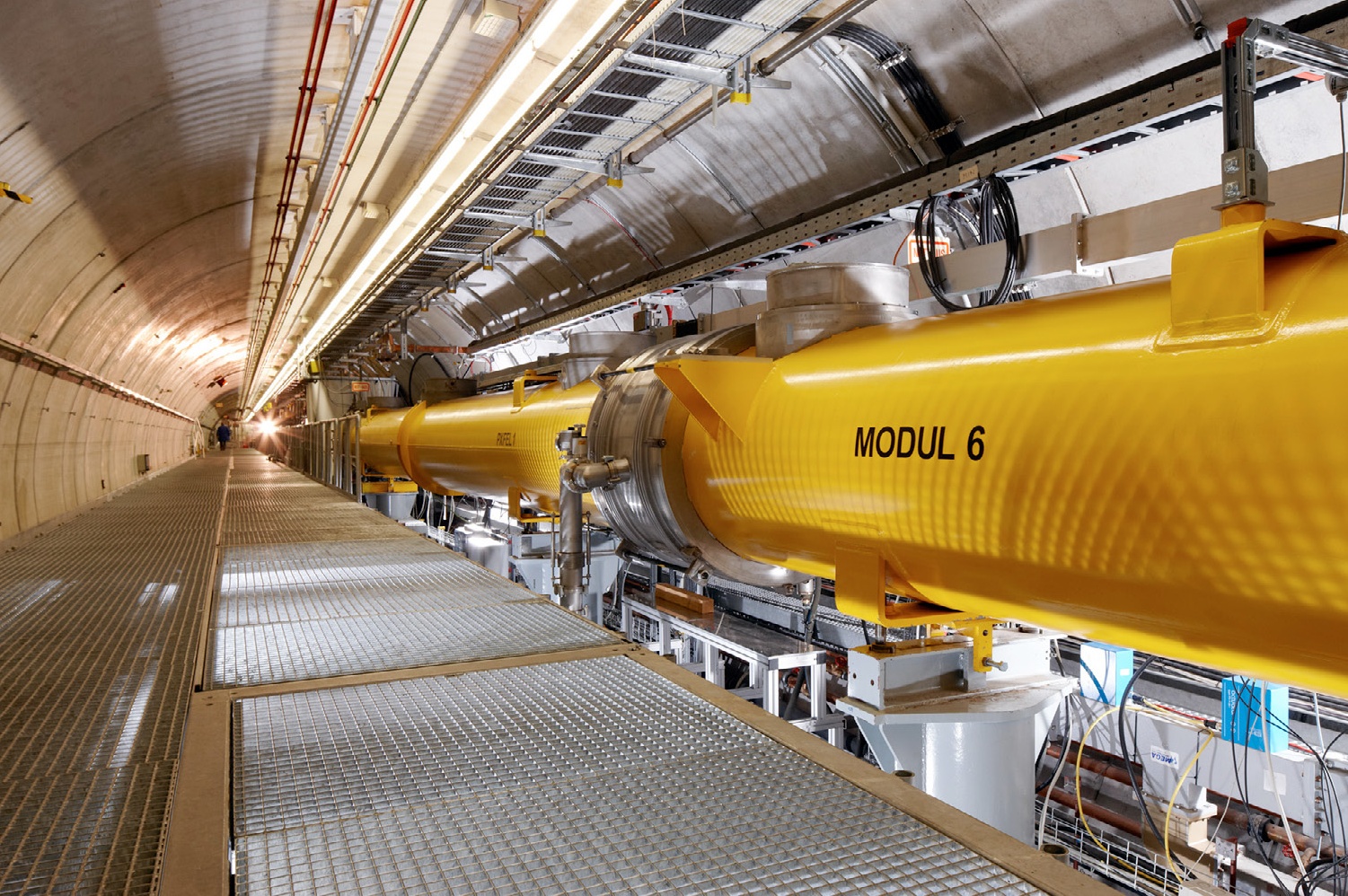
FLASH superconducting accelerating modules. Seven modules are installed, each module has a length of 12 m.
FLASH: from the extreme ultra-violet to the water window
The FLASH accelerator is equipped with seven 12 m long TESLA-type superconducting accelerating modules. Each module contains eight 1 meter long superconducting accelerating cavities operated a radio frequency of 1.3 GHz. The cavities are made of solid niobium and are cooled by liquid helium down to 2 K. At this temperature - just 2 degrees Celsius above the absolute zero -, niobium is superconducting so that the acceleration field can be applied with very small losses. This makes a superconducting accelerator very efficient.
Right after the installation of the seventh module in 2010, the FLASH team accelerated an electron beam to an energy of 1.25 GeV. With this energy, soft X-rays with a fundamental wavelength of 4.1 nm could be produced. For the first time FLASH has generated soft X-ray FEL radiation in the so-called water window. So far this was only possible at FLASH with the third and fifth harmonic of the fundamental wavelength, which are by a factor of thousand fainter.
The water window is a wavelength region between 2.3 and 4.4 nanometers. In the water window, water is transparent to light, i.e. it does not absorb FEL light. This opens up the possibility to investigate samples in an aqueous solution. This plays an important role especially for biological samples, because carbon atoms in these samples are highly opaque to the X-ray radiation, while the surrounding water is transparent and therefore not disturbing.
Parameter |
FLASH1 |
FLASH2 |
|---|---|---|
Electron beam energy |
0.35 - 1.35 GeV |
0.4 - 1.35 GeV |
Normalised rms emittance at 0.4 nC |
0.4 mm mrad |
0.4 mm mrad |
Energy spread |
200 keV |
500 keV |
Electron bunch charge |
0.01 - 1.2 nC |
0.01 - 1 nC |
Peak current |
1 - 2.5 kA |
1 - 2.5 kA |
Electron bunches per second |
5000 |
5000 |
Photon energy (fundamental) |
24 - 360 eV |
14 - 370 eV |
Photon wavelength (fundamental) |
51 - 3.4 nm |
90 - 3.3 nm |
Photon pulse duration (FWHM) |
30 - 200 fs |
10 - 200 fs |
Peak Power |
1 - 5 GW |
1 - 5 GW |
Single photon pulse energy (average) |
1 - 500 µJ |
1 - 1000 µJ |
Spectral Width (FWHM) |
0.7 - 2 % |
0.5 - 2 % |
Photons per Pulse |
1011 - 1014 |
1011 - 1014 |
Peak Brilliance |
1028 - 1031 B |
1028 - 1031 B |
FLASH has a bright THz source
FLASH1 is equipped with an electro-magnetic undulator able to produce Terahertz (THz) radiation pulses. The THz pulses are produced by the same electron bunch than the SASE radiation. Therefore, both pulses, the soft X-ray and THz are perfectly synchronized (better than 5 femtoseconds).
Parameter |
THz |
|---|---|
Wavelength |
10 - 230 µm |
Photon energy |
5 - 125 meV |
Photon frequency |
1.3 - 30 THz |
Photon pulse energy (average) |
10 - 100 µJ |
First external seeding at 38 nm
The FLASH1 beamline has a section equipped with variable gap undulators for seeding experiments (sFLASH). In April 2012, first seeding at 38 nm has been obtained. The seed source was radiation from high harmonic generation (HHG). An external femtosecond short laser pulse is focused into a gas cell producing higher harmonics of the laser wavelength. This radiation is overlapped with electron bunch and seeds the amplification process in the undulators. The advantage compared to SASE is the narrow bandwidth of the radiation pulses. This is advantageous for certain classes of experiments, where a small bandwidth is required. Today, the sFLASH experiment concentrates under the new name Xseed on the preparation of external seeding in the frame work of the FLASH2020+ project.
The FLASH Accelerator
FLASH is a high-gain free-electron laser (FEL) which achieves laser amplification and saturation within a single pass of the electron
bunches through a long undulator section. The lasing process is initiated by the spontaneous undulator radiation. The FEL works in the so-called Self-Amplified Spontaneous Emission (SASE) mode without needing an external input signal.
The electron bunches are produced in a laser-driven photoinjector and accelerated by a superconducting linear accelerator. The RF-gun based photoinjector allows the generation of electron bunches with a tiny emittance - mandatory for an efficient SASE process.The superconducting technique allows to accelerate thousands of bunches per second, which is not easily possible with other technologies. At intermediate energies of 150 and 450 MeV the electron bunches are longitudinally compressed, thereby increasing the peak current from initially 50 to 80 A to 1 to 2 kA or more - as required for the SASE process to develop.

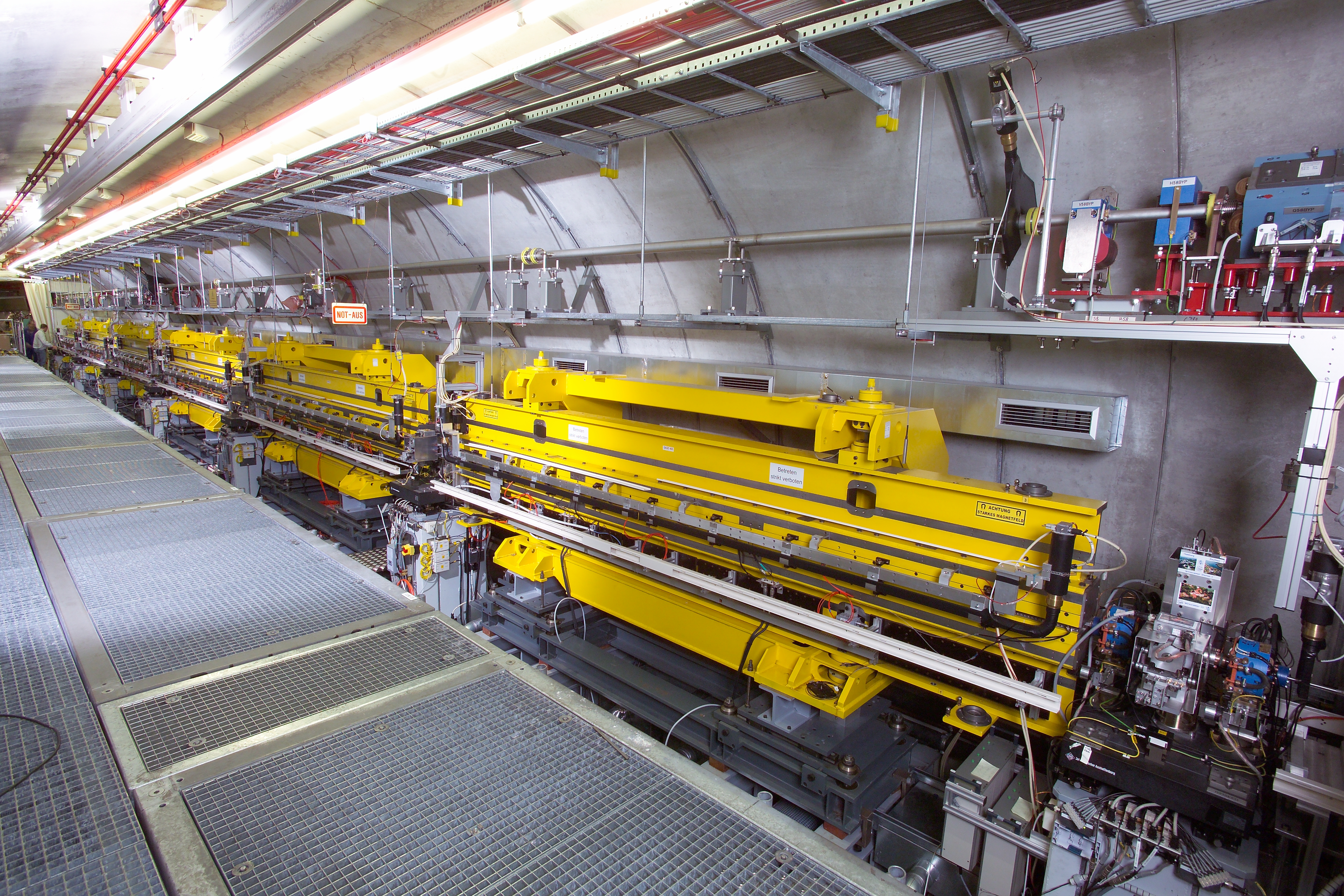
The FLASH1 undulators.
FLASH1 has a 27 m long undulator made of permanent NdFeB magnets with a fixed gap of 12 mm, a period length of 27.3 mm and peak magnetic field of 0.47 Tesla (K=1.23). The electrons interact with the undulator field in such a way, that so called micro bunches are developed. These micro bunches radiate coherently and produce intense X-ray pulses. Finally, a dipole magnet deflects the electron beam safely into a dump, while the FEL radiation propagates to the experimental hall.
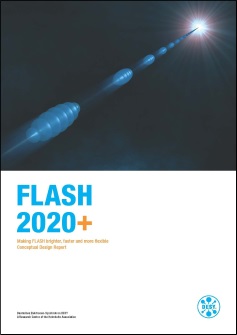 FLASH2020+ Conceptual Design Report
 FEL2019


